
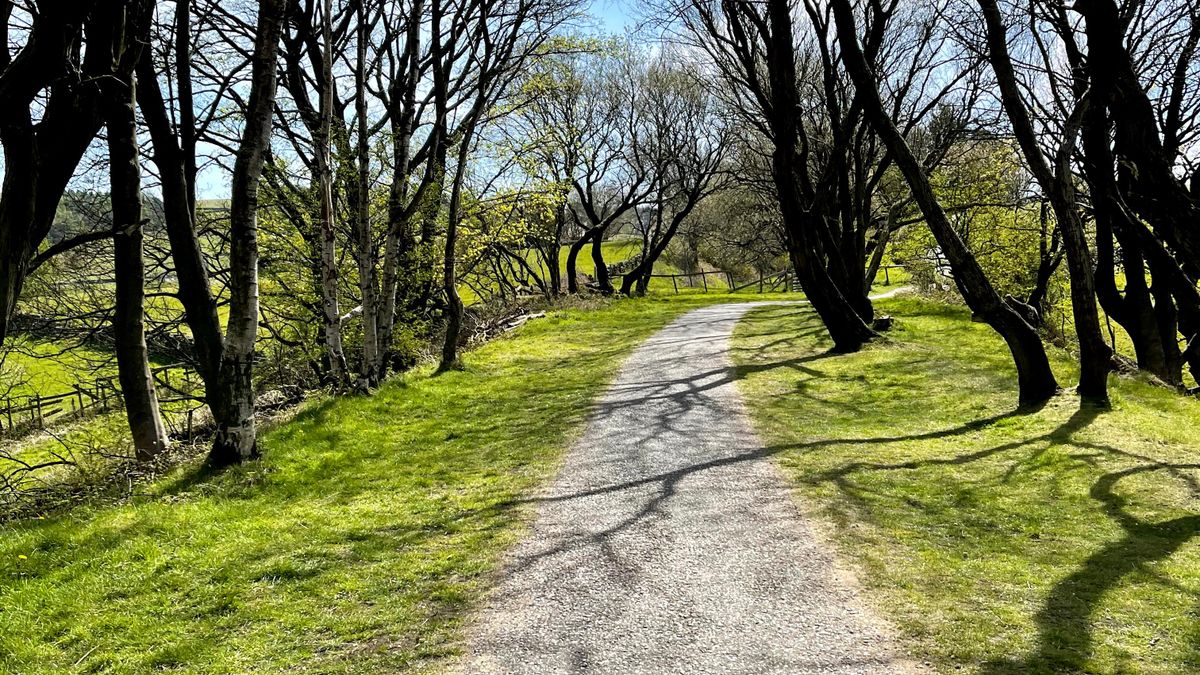
Water is endlessly interesting to small children. Ducks, geese, moored boats, ripples, reflections, the odd heron standing motionless in the shallows — there is always something to point at, which buys you far more walking time than a lane through a housing estate ever will. Rivers and canals also tend to run gently downhill or stay entirely level, and they usually come with a ready-made linear route: you walk out, you turn round, you go back. No navigational headaches, no map reading while a toddler lobs a bread crust at a swan.
The other great advantage is that riverside corridors are often the flattest paths in the landscape. Canal towpaths were built for horses hauling narrowboats, so they were deliberately kept level and wide enough for a working animal. Many have since been surfaced and reopened as walking routes through the middle of towns and countryside alike. That makes them a realistic option for a buggy, a balance bike, a scooter and a four-year-old who insists on walking but will almost certainly end up riding.
A route described as "easy" in a guidebook is not always easy with wheels underneath. Use these checks before you commit to a full day out:
Your pushchair matters as much as the route. A three-wheeler or four-wheeler with pneumatic tyres and a lockable front wheel will roll over compacted gravel and short grass without complaint. A lightweight stroller with tiny solid wheels is brilliant on tarmac and miserable on anything else. If you only own the latter, stick to surfaced towpaths, country park riverside loops and disused railway paths that follow valleys.
Watch the weather. A river that looks calm and shallow in July can flood a towpath after a fortnight of rain, and muddy sections persist for days. Estuary and tidal river routes need tide tables rather than guesswork — a wide, dry gravel bank at low water can be waist-deep in half an hour. In summer, riverside paths are often the coolest option available, shaded by willows and alders, but nettles and brambles encroach on narrow sections, so long trousers for the children are sensible.
Two to three miles is a realistic target with a child in a buggy; much more than that and you are doing it for yourself rather than them. Plan the turnaround at a landmark — a lock, a weir, a picnic bench, a bridge — so there is a reward and a clear sense of achievement. If a confident walker wants to stretch their legs, let them walk a section and ride the rest, and consider taking a back carrier as insurance for the journey home.
Pack for the actual day: spare socks, a change of clothes, wipes for muddy hands and duck-pond fingers, water, and more snacks than you think you need. Public toilets beside rivers are patchy, so a changing mat and a discreet plan B are worth having. Most car parks at riverside country parks fill by mid-morning on sunny weekends, so arrive early, and check closing times — many rural car parks and access gates are locked at dusk.
Towpaths are shared spaces. Cyclists commute along them, anglers sit quietly for hours, and boaters step suddenly out of lock gates. Keep children on the inside of the path, away from the water edge, and hold hands near locks, weirs and mooring points — there are rarely barriers, and the drop is often sheer. Never let a pushchair be parked on a slope facing the water, even for a moment, and always apply the brake.
Give swans and geese space, particularly in spring when they are protecting cygnets and goslings. Feed bread sparingly, if at all, and never let children dangle over the edge. Dogs should be kept close and under control around nesting birds and livestock, and gates closed behind you.
Start with what is closest. Local canal towpaths, riverside country parks, nature reserves with boardwalk loops, and old railway lines converted into trails are the most reliable bets. Look for routes described as level, surfaced and circular, and check recent reviews for mentions of mud, flooding or overgrown sections. A river path walked in both directions, with a bench halfway and a cafe at the end, is about as good as a family day out gets. Take it slowly, stop often, and let the water do the entertaining.

Hi, my name is Anthony kuber. I am artist and fashion designer.
I love to travel and writing blogging.
Your email address will not be published. Required fields are marked *
Software Developer & Writer
Hey, I'm Diva, a developer and writer blending code and creativity. I'm driven by a deep curiosity and a relentless pursuit of excellence. Join me as I craft digital solutions and captivating stories.


